The Development of Freezing Technology
The frozen food market has experienced remarkable growth over the past two decades, driven by continuous advancements in freezing technology. Notably, the COVID-19 pandemic accelerated this development as the food service industry temporarily stalled, leading to a surge in demand for prepared foods and home meals. Additionally, the rise of single-person households and increasing female workforce participation have contributed to this trend.
In this context, freezing technology, particularly modern "flash freezing" techniques, has played a crucial role in expanding the frozen food market. Japan boasts the world's oldest history of freezing technology development, and innovations continue to this day.
A Revolution in Freezing Technology
Flash freezing technology is essential for the production, preservation, and distribution of food, catering to takeout and delivery services. To ensure quality, the industry adheres to strict standards, requiring temperatures to be maintained below -18°C throughout the process from production to consumption.
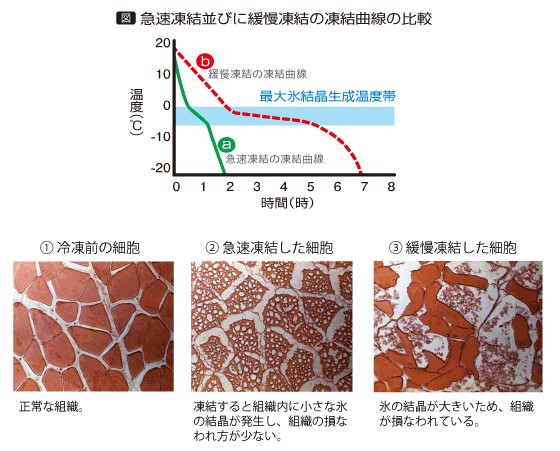
Previously, traditional freezing methods were often perceived as detrimental to food quality, leading many to believe that frozen foods were less tasty. However, flash freezing technology has completely changed this perception. By rapidly freezing food within a very short time frame, it prevents the formation and growth of large ice crystals, which are primarily responsible for damaging product quality.
The Secret Behind Flash Freezing Technology
During the freezing process, temperatures ranging from -1°C to -5°C are ideal for forming the largest ice crystals. If food undergoes slow freezing, it remains in this temperature range longer, allowing ice crystals to develop and destroy cell structure, thus degrading product quality. In contrast, flash freezing technology enables food to quickly "pass through" this dangerous temperature zone, minimizing cellular damage and allowing for superior quality preservation.
*The Development of Freezing Technology
Advanced Freezing Technology: The Key to Long-lasting Freshness
Shelf life and consumption time are always core issues in the food industry. While freezing technology has been widely adopted as a breakthrough solution to prevent spoilage and reduce food quality deterioration, traditional methods can only preserve products for a few months. However, today's most advanced freezing technologies can extend preservation periods up to several years or even decades. When stored under appropriate conditions, thawed foods can retain freshness nearly identical to their original state.
Rapid freezing devices are being widely introduced and have been adopted by many major companies in Japan, including restaurant chains, supermarkets, and large wholesalers. For example, a famous barbecue restaurant chain has utilized this technology to preserve premium beef across its branches, ensuring a consistent quality supply for customers. The secret to preventing meat from "leaking" after thawing lies not in the meat being "fresh" but rather in the flash freezing technology itself.
Despite its numerous benefits, this technology remains relatively unknown. Many businesses use it in their food processing but do not publicize it due to existing prejudices against frozen foods. However, with its ability to maintain near-perfect freshness preservation, you may have unknowingly enjoyed dishes prepared using this technology without realizing they were once frozen.
Freezing technology deserves the title of "silent hero" making significant contributions to the development of Japanese cuisine.
Kyouwa Vietnam is a company fully invested by Japan and is committed to trading imported freezing equipment directly from Japan to Vietnam. We ensure that each customer thoroughly tests the machines before making a decision; additionally, we provide free maintenance services twice a year. Please contact us for more detailed advice.